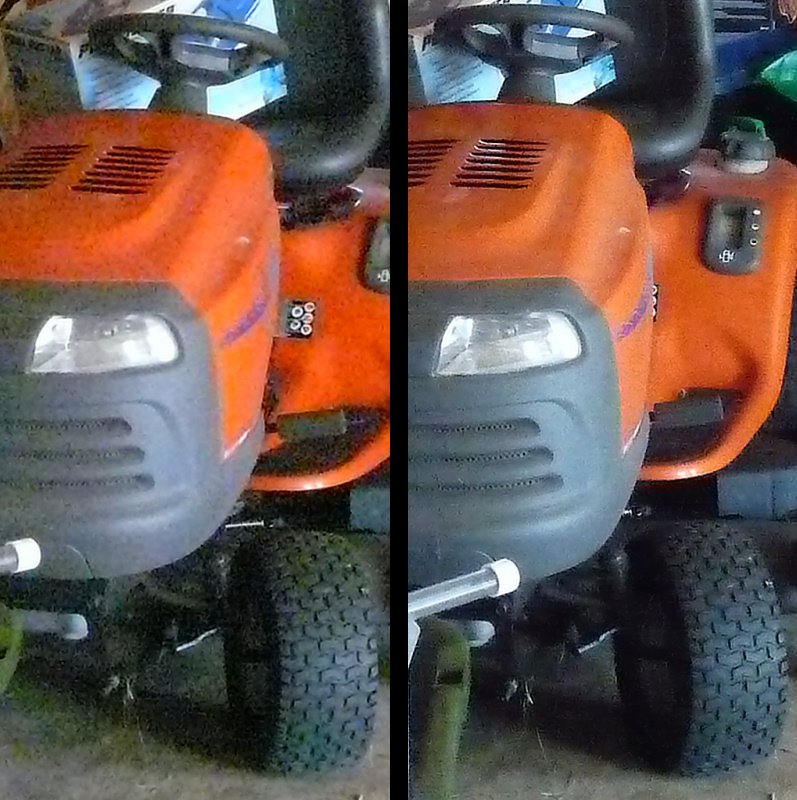
It all started innocently enough with speculation about the DMC-FZ28's image quality at the higher ISO settings. Traditionally, small cameras like the FZ28 work fine at ISO settings of 100 or 200, but the pictures get really noisy at any higher setting. The FZ18 was good at the lower settings, but started to show noise at 200 and above.
So I set the FZ28 for ISO 1600, went into my garage, and took a few shots. The results were pretty bad. Barely usable, even with lots of noise removal applied in post processing. I must be doing something wrong.
And, by golly, I was. When I went to the menus and checked my current settings, I had Noise Reduction turned off. I had used that setting as it can yield sharper images at lower ISO settings. But what about at ISO 1600? The FZ28 sports a new and improved processor called the Venus IV. Why not give it a chance and see what it can do?
So I set the Noise Reduction to +2 and got a very different result. I tried the same setting on my FZ18 and then put them side by side. Hmmm... The results are shown above. (Note: The pictures were taken from a slightly different angle as I had to go back into the studio to get my other camera. The same amount of sharpening was applied to both images in post processing.)
As you can see, the image from the FZ28 is a lot better than the one from the FZ18. Notice the amount of noise in the FZ18's picture, especially in the darker areas, or in areas where there is no detail. For high-ISO pictures, the FZ28 is certainly a noteworthy improvement over the FZ18.
Maybe it's not the same image quality as you get with a big fancy DSLR, but very, very good for a tiny camera like the FZ28.The camera certainly is very usable at its highest ISO settings. (These are the first shots that I took, and I'll post some more in the future.)
Some feel that allowing the camera to remove noise or sharpen the image will ruin the resulting image and, for many years this was true, with noise reduction that smeared images, and sharpening that left white halos around things. I was one of these people, which is why I had the Noise Reduction on the FZ28 initially turned off.
But the camera manufacturers have been making great strides with their processors. The FZ18 showed that it's possible to correct lens distortion and color fringing inside the camera. They also showed that a camera's automation can make better decisions about things than the average photographer.
The FZ28 adds a new processor that does a great job with noise removal. I tried removing the noise from some high-ISO shots from the FZ28 myself, using commercially available noise-removal software. It was it a finicky job, different for every picture. But after all my efforts, I was outdone by the camera's Venus IV Processor.
The camera's internal processor won't entirely eliminate the need for post processing -- touching up your pictures on the computer to bring out their very best. You'll still need to fix things like exposure and color balance, and don't forget cropping or reducing the image to email size.
But things like noise removal and sharpening fall under the area of "signal processing," high-speed manipulation of data in real time. This can be done better by internal processors designed to exactly match the characteristics of the camera's sensor and lens.
What's next? Well, I only tried 1600 ISO, as that was the highest setting and I figured that if it worked, lower ISOs would be even better. I only tried setting the noise reduction at +2, its highest setting. And, as I mentioned above, I sharpened the test images in the computer. Lots of variables to experiment with.
For each of the higher ISOs (400, 800, 1600), I could try different levels of noise reduction. And perhaps the in-camera sharpening will do a better job in sharpening high-ISO shots than I did on the computer. Noise removal and sharpening are two things that take up lots of time in computer post-processing. If you let the camera handle it for you, there's a chance it might do it better than you. And think of all the time that you could save if it works out.
So maybe it's time to take a Zen approach to this and try and become one with the camera rather than fighting it. Philosophy, rather than technology. Try and think like the people who designed the camera and how they imagined it would be used. Think about how much of the process has to be done on your computer and how much can be trusted to the camera.
Now we need a way to tie all of this together and make it easy to shoot at the higher ISOs while still getting the best image quality.
Stay tuned.
Copyright 1957-2023 Tony & Marilyn Karp